 |
330 GT Registry |
|

Hemmings Motor News/February
2018
1964-’67 Ferrari 330 GT
A Ferrari fit for a family and for driving, too
By Terry Shea
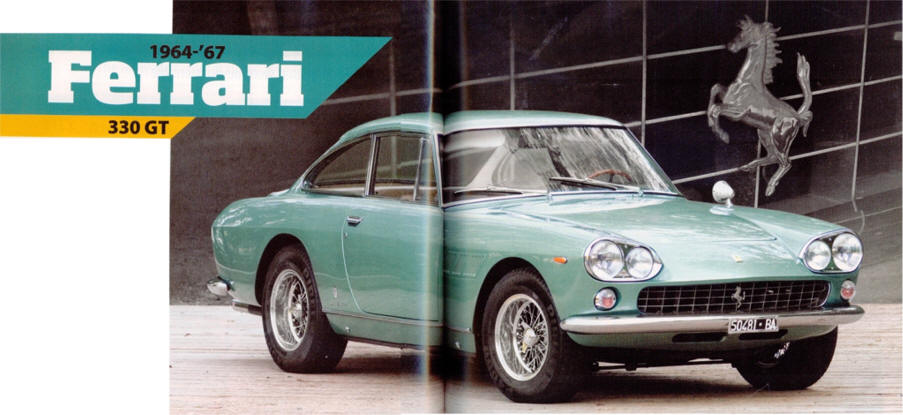
Legend has it that Enzo Ferrari merely tolerated building road cars as a way to pay for the racing efforts of Scuderia Ferrari. Perhaps, but Ferrari’s world-dominating competence at race tracks around the world in the 1950s and ’60s, in both formula cars and sports cars, was alive and well in the street cars that came from its Maranello, Italy, factory. You could even say that Ferrari as a company was growing up at the time, no longer offering just hardcore sports cars for the enthusiast, but also proper GT cars.
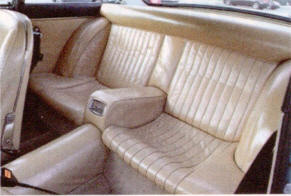
The Ferrari 330 GT, sold from 1964 through 1967, was indeed a true GT car, offering 2 + 2 seating that could actually accommodate four adults, a lusty V-12 under the hood, and enough leather, wool, and brightwork to satisfy any buyer plunking down the then sky-high $14,200 price of entry. The 330 GT was not groundbreaking in any particular measure, but by the time its production wrapped up in 1967, it had become the most successful Ferrari to date.
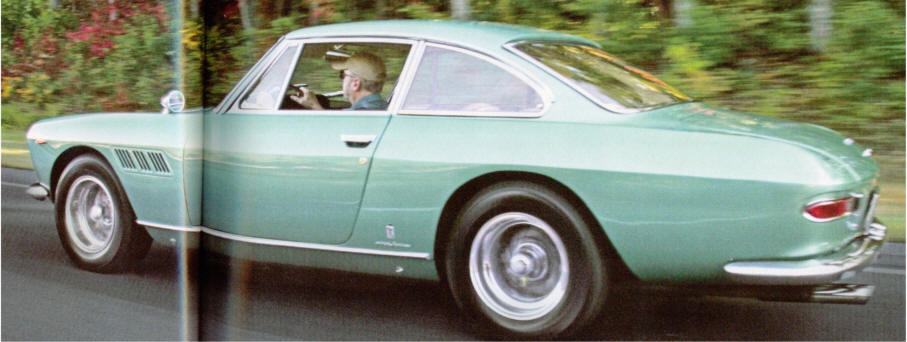
IThough not Ferrari’s first foray into a car that sat more than two people—that distinction belonged to its predecessor, the 250 GTE/330 America—the 330 GT featured a chassis with an additional 2 inches of wheelbase length over the earlier cars. Those extra 2 inches in length between the axles gave noticeably more room for rear-seat passengers, though it would never be confused for a proper sedan. Ferrari fabricated the frame in the same manner it had used on previous cars: using large oval tubes connected by several crossmembers, aided by significant subframes welded to the main frame for suspension and driveline support. As with the 250 GTE, Pininfarina, the Turin-based automotive-design powerhouse, created the 330 GT’s body. Though neither as lithe nor as subtle as some of Pininfarina’s other looks for Ferrari, the 330’s body lines emerged from the pen of American designer Tom Tjaarda, still then just making his mark at the start of what would be a prolific career. The 330’s body shell remained distinctly Ferrari, with a long hood to cover the V-12 and a short trunk giving it a sporty look. Its mismatched, four-headlamp front end, however, proved controversial almost from the beginning. With the outer lamps 7 inches in diameter and the inner lamps at 5 inches, the tops of the fenders canted downward a bit toward the hood.
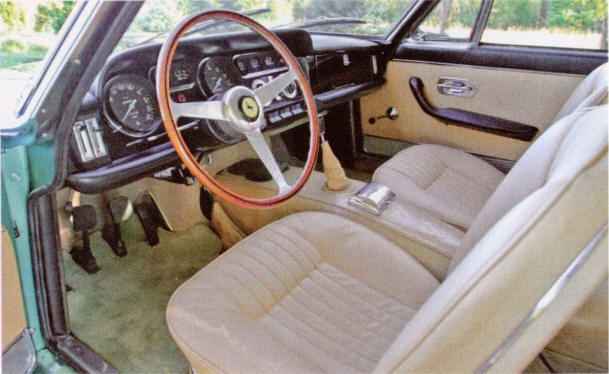
Inside, a large steering wheel— practically a necessity in a car weighing around 3,400 pounds and with no power steering—was perched in front of a full set of gauges, with a large speedometer on the left and an equally big tachometer on the right, with a series of ancillary gauges in between and in the middle of the instrument panel. Connolly Leather of the U.K. provided the hides required to swathe the car in acres of leather. Wool carpets added to the luxurious feeling.
In 1947, Gioacchino Colombo designed Ferrari’s first engine, a high-compression, overhead-cam, 1.5-liter mill that produced 118 horsepower and powered the 125 S to the company’s first victory in a car bearing Ferrari’s own name. This engine, a 60-degree V-12, said to be inspired by Ferrari’s respect for the Packard V-12, among others, grew in displacement over the years, powering a vast number of racing and street models for Ferrari.
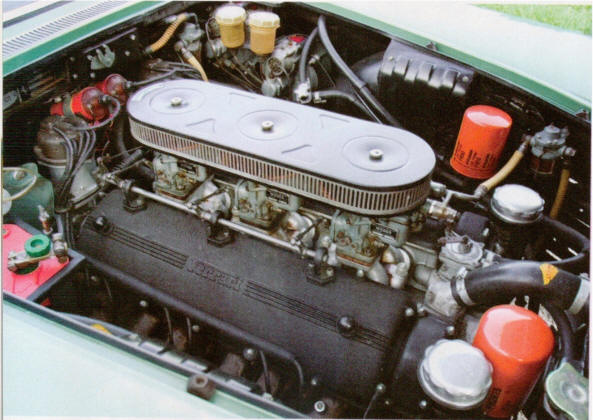
Per Ferrari convention of the day, the 330 name represented the displacement of each cylinder. With a 77-millimeter bore and a 71-millimeter stroke, each cylinder measured a bit over 330 cubic centimeters. In total, the engine displaced 3,967 cc. A previous model, the 400 Superamerica, had also used the same bore and stroke, but for the 330, Ferrari’s engineers increased the size of the block to allow for additional coolant passages.
Ferrari spec’d the 330’s engine with an 8.8:1 compression ratio and three Weber two-barrel carburetors, along with two coils and two distributors—one for each bank of six cylinders. With an overhead camshaft operating two valves per cylinder on each bank, the Colombo engine was known for making peak power very high in the rev range, and the 330 GT’s V-12 was no different, rated at 300 hp at 6,600 rpm.
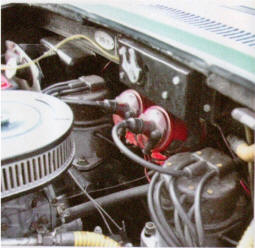
Power was put down to the rear wheels via a four-speed transmission with an electrically engaged overdrive. While the front suspension was an independent affair, with upper and lower A-arms with coil springs, tubular shocks, and an anti-roll bar, the solid-axle rear featured semi-elliptic leaf springs, longitudinal pushrods, an anti-roll bar, tubular shocks, and auxiliary coil springs.
Car and Driver magazine noted in 1965 that piloting the Ferrari was not for the faint of heart, despite its family car intentions, writing: “It is hard to drive, in that the controls are stiff, heavy, and hyper-accurate. The effort required and the neophyte’s tendency to under-control have an intimidating effect upon the faint-of-heart. The engine occasionally spits back through the carburetors in a snort of contempt when the clutch is not engaged smoothly or the revs are allowed to get too low. It knows it was meant to go fast and it sulks and surges and overheats when it gets balked in heavy traffic. The ride is harsh as hell on any surface at any speed under seventy-five, but smooth as glass at anything over eighty.”
The production run of the 330 GT was extremely low when measured against almost any other manufacturer’s output. The manufacturer updated a number of features along the way, including a rather significant change to the styling that marked the beginning of what was known as the 330 GT Series II.
During the 1965 model year, Ferrari replaced the four-speed transmission and its electric overdrive with a proper five-speed gearbox. It also took the opportunity with the transmission swap to move the pedals from a floor-mounted to a hanging position. Apparently, the floor-mounted pedals left the floor readily prone to rusting. At the same time, the mechanical clutch was tossed in favor of a hydraulically actuated one. Half-inch-wider tires also came with these changes.
Ferrari’s decision to take the Tjaarda design, with the twin headlamps on each side, did not sit well with customers, so it revised the Series II cars, necessitating significant alterations to the front end. Most noticeable were the single headlamps and the reworked fenders and front-end sheet metal to accommodate them. Designers moved the turn signals and also added overriders to the front bumper. Power steering and air conditioning became options with the Series II as alloy wheels became standard, with wire wheels still an option. Other changes included moving the fuel filler cap from the left to the right side and some minor mechanical updates, such as using a Bonaldi brake booster in place of the original’s Dunlop unit.
Between late 1963 and 1967, Ferrari produced some 1,087 330 GT models, split between 627 Series I and 460 Series II examples, with the majority in lefthand drive, and 95 with right-hand drive. For many years, the 330 GT was a bargain Ferrari, particularly the early examples with the paired headlamps. Buyers of the single-headlamp cars paid a premium for the more classic look, despite the cars being very similar mechanically.
Today, of course, the idea of a “bargain” Ferrari seems absurd, particularly when talking about a V-12 model from the ’60s. But given the stratospheric prices, we were pleasantly surprised when we met Tim Gallagher, the owner of the 1964 Series I car pictured here. While stationed in Germany as a U.S. Army doc in 1973, Tim bought the car, which then had just 20,000 km (12,000 miles) on it. Tim shipped the Ferrari to the U.S. in 1976 and has driven it an additional 167,000 km (104,000 miles) since.
SPECIFICATIONS
Engine SOHC V-12, cast-iron block
Displacement 3,967 cc (242-cu.in.)
Horsepower 300 @ 6,600 rpm
Compression ratio 8.8:1
Transmission Four-speed manual with electrically engaged overdrive
Steering ZF worm and roller, unassisted
Brakes Hydraulic, 12-inch discs
Wheelbase 104.2 inches
Weight 3,430 pounds
Total production 1,087